Wednesday, September 11, 2013

ONE FISH, TWO FISH, RED FISH, MIKE'S FISH !!!!

Fly fishing is a favorite activity of guests at Shepp Ranch.  It is especially a favorite of Mike's, manager of Shepp Ranch.  So, one lovely summer evening Mike and I went fly fishing.   Mike took me to four of his favorite fishing holes on Crooked Creek.  The first hole is just under the first bridge headed towards the air strip.  There Mike reviewed with me my fly casting.  He immediately caught a fish.  I just practiced my casting.

Mike fly casting . . . . . .
 
Favorite flies Mike used this summer include Zug Bugs, ___________, _______________, _________________ and ___________________.  These are all what he terms 'dry flies,' which means they stay on the surface of the water as opposed to sinking under.  Much to my amazement, Mike seems to catch a fish on virtually every cast.  All of the fish caught on Crooked Creek by Mike are 'catch and release' for him.  In this way he will know where guests can catch that big one in the future.
 
 
Reeling one in . . .
 
and another . . . 
 
The fish caught are Rainbow Trout, Cutthroats and Brookies.  On this evening I did not catch a fish on my own.  Mike allowed me the privilege of reeling in one of his, but alas, I lost it.  The fish are anywhere from 1/2 pound to 1 1/2 pounds. 

 
Mike and a guest catch one up Crooked Creek.  Notice the dogs always go along on fishing expeditions . . .
 
A beautiful rainbow trout taken one day up by Arlington Creek where Mike and Lynn were camping and fishing for a few days . . . .
 
Steelhead fishing is reserved for spring and fall.  Trout fishing with light fly tackle is for summertime.


Wednesday, September 4, 2013

DAY TRIPPING TO CAMPBELL'S FERRY

I lived at Campbell's Ferry on the Salmon River for a month, about 34 years ago.  I was there with an old mountain woman, Frances Wisner, 38 years my senior.   I was 29, Frances was 67.  My daughter Katy, then 8 years old was also with me.  I learned many things from Frances that year.  The one thing that has stayed with me is:   "one must learn to be content with day to day living, whatever that life might be."
Frances and dog Gretchen by the woodpile:  circa 1979
 
Lorrie & Katy on the Salmon River:  circa 1979
 
This day trip started with the Wednesday morning mail plane. Ray picked me up at 9:00 Wednesday morning, August 29th.  We flew about 30 miles up river to Campbell's Ferry.  The Ferry airstrip is one of the more difficult on the Salmon River as it is short and  an uphill landing. 

Flying up river to the Ferry in the Cessna . . . looking up  river into the Salmon River Canyon . . .
 
Landing the Cessna at the Ferry . . . It started sprinkling as we approached the airstrip. . . .
 
I had breakfast with Phyllis and Doug Tims and their Vizsla, Rita.  The are now the owners of Campbell's Ferry. They have had it since some time in the 80s.  Doug and Phyllis have transformed Frances' cabin into a museum of sorts.  Over the past few months I have been sending them some of Frances' things which I took with me after her death in 1986.  I had her oil lamp base, a few tin dishes, the antlers which hung over her bedroom door, her pencil case and a few books.  This time I took them the last of the things I was to donate to the cabin, the oil lamp base and the antlers.  There is  a web site now for the Ferry found at  www.campbellsferry.org .   Doug and Phyllis have also written a book, Merciless Eden, which is an historical account of Campbell's Ferry and all who lived there.  More information about the book can be found at  www.mercilesseden.com.

Phyllis, Doug and their Vizsla pup Rita at the cabin . . . ..
 
After breakfast we walked down to Frances' cabin where Doug hung the antlers over Frances' bedroom door. 

Frances' cabin at Campbell's Ferry  . . . .
 
Another view of the front of the cabin . . .
 
Doug mounts the antlers over Frances' bedroom door . . . .
 
Frances' leather chaps . . .donated back to the Ferry cabin by Marlene West
 
Frances' desk area in the back of the cabin where she sat most of the day .  . wrote and smoked :-)
 
I played a few fiddle tunes for Doug and Phyllis . . . the first I had ever played in that cabin . . . Irish Washerwoman and Haste to the wedding.  Back in 1978 I played those tunes with my friend Linda Wolfe Karki who was there visiting with Frances at the time.  Linda grew up on the River at Rhett Creek, just a few miles down River from Campbell's Ferry.
 
Me and my fiddle  in Frances' cabin. . . sitting on a chair made by Jim Moore
 who lived across the river from Frances in the 40s.
 
Linda Wolfe Karki playing fiddle at a party at Buckskin's:  circa 1987?
 
I sat on the oven door of the great Majestic woodstove that sits in the cabin kitchen.  I used to sit there with the woodstove warm.  Frances called this the warmest seat in the cabin.  The Majestic was floated down the river on a wooden scow (wooden raft of sorts) back in the 40's I think. 
 
...
 The Majestic Woodstove . . .  It is the biggest woodstove I have ever seen . . .
 
Oven door  of the Majestic, where I sat and talked with Frances on cold days . . . .
 
I took a walk by myself down to the pack bridge built in the 50s that replaced the actual cable ferry, hence the name Campbell's Ferry for the ranch.  It is named after the individual who ran the first ferry across the river.

Pack Bridge at Campbell's Ferry crossing the Salmon River . . .
 
Trail Marker for the pack bridge . . .
 
I had lunch with Doug and Phyllis at their cabin near the airstrip.  We talked of my days living with Frances and they showed me videos and pictures of the 100th birthday party/friends and family reunion which they had at the ferry for Frances back in June of this year.
 
Gathering at Campbell's Ferry celebrating Frances' 100th birthday, June 2013 . . .
 
Ray came to pick me up at 1:30 in the afternoon.  Around Mackay bar he took the Cessna down to the river - about 10 or 20 feet about the water.  We cruised from there to Polly Bemis Ranch whereupon Ray banked the plane up and over Shepp Ranch.  We viewed the airstrip to be sure it was clear and had a safe landing. 
 
Take off  of the Cessna off the Ferry airstrip . . .
 
Flying high above the Salmon River . . . .
 
Flying 10-20 feet above the surface of the Salmon River . . ..
 
Approach . . . Scouting the Shepp Ranch airstrip for game or stock  . . . .
 
It was an emotional day for me.  I had not been back to the Ferry since my days as a young woman.  I have many poignant memories there of love lost, time with Frances and special days with my daughter Katy.
 
And life goes on.
 
This is Katy, now at age 40, a small animal veterinarian practicing in Freeport Maine . . .


Saturday, August 24, 2013

LUCKY H HORSESHOEING VISITS SHEPP RANCH

It is once again time to give those horses and mules new shoes!! The horses at Shepp Ranch are shod three times per year and always just before hunting season.  Shepp Ranch horseshoe man is Shane Hendren, sole owner/proprietor of Lucky H Horseshoeing. Shane has been a farrier for 11 years.   He went to farrier school in Oklahoma for 6 weeks and has had a few very special mentors along the way.  Shane shoes about 750 head of stock a year.   He charges $60 a head, or $15 per shoe.  Not bad for such precise, difficult and potentially dangerous work.  Horses and mules are shod for the same reasons we wear shoes, for protection.  Pack animals in the mountains especially need shoes as they are walking on steep trails over rocks and crevices which can sometimes be treacherous.

For horseshoeing Shane wears a piece of protective clothing called chaps.  The chaps you see below were made by Jerry Combs in Clarkston WA, a friend and mentor of Shane's.  They are made of very thick leather which prevent any nails from driving into Shane's legs as he shoes and in general they are just for soft tissue protection.

Shane wearing his protective chap . . . . . . . .
 
Shane has his toolbox which he usually takes right next to the mule or horse while he is shoeing.  If the animal is in any way skittish he will not take his toolbox too close.
 
Shane's quasi toolbox . . . Most farriers have a traditional tool box . . . .
 
Shoeing starts by pulling off the old shoes.  Here Shane uses shoe pullers and a clinch cutter to remove the old nails and subsequently the shoe.
 
Removing the old shoes . . . . . .
 
Next he cleans out the hoof of any debris and caked in dirt with a hoof pick.

Shane cleans out the hoof with a hoof pick  . . . ..

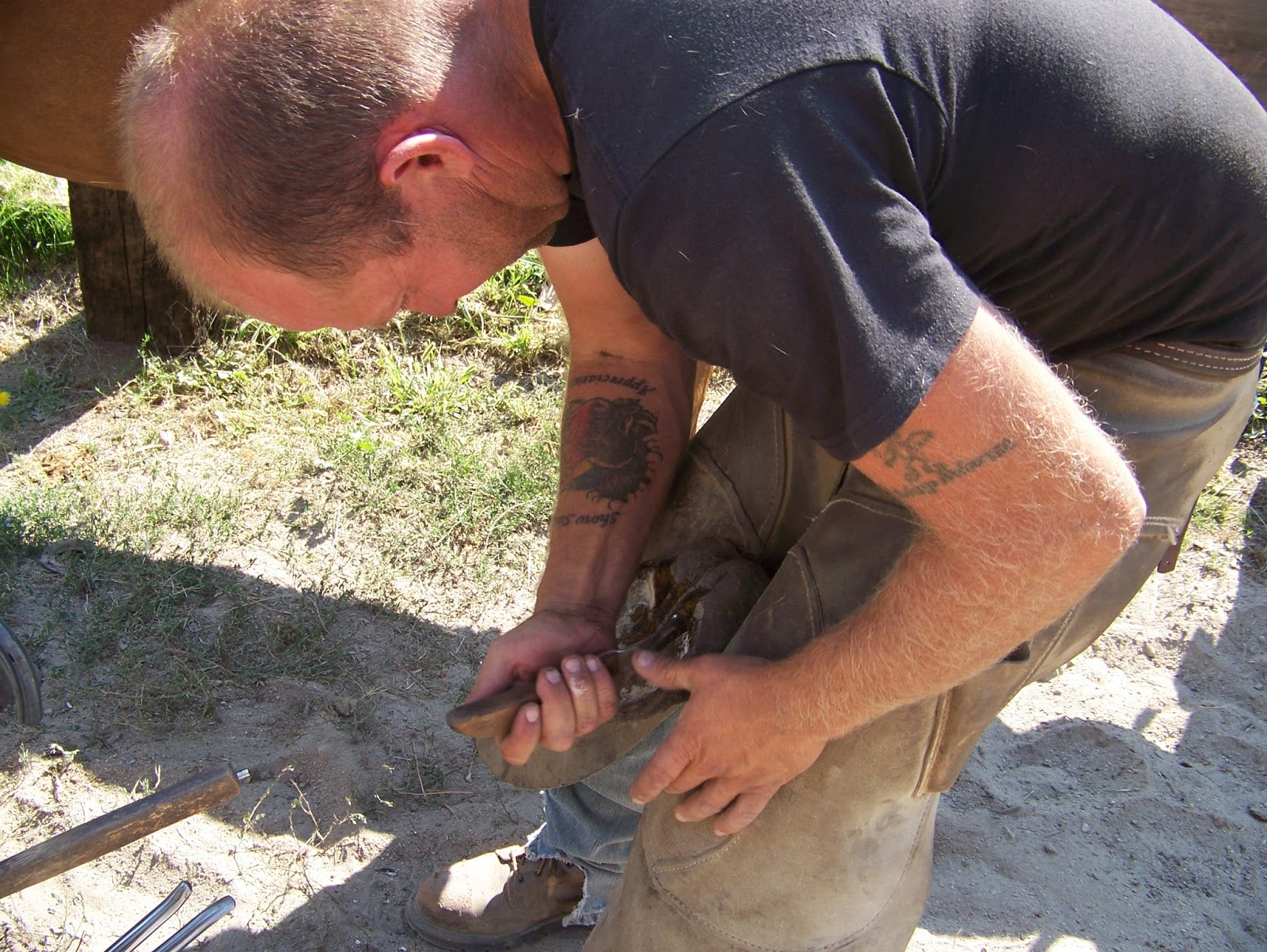
Then he trims the outside of the hoof that has grown since the shoeing with a tool called nippers.  He trims down to the 'white' part of the hoof, which is not the 'quick' as we have under our nails.  The animal feels no pain during this process.

Trimming the hoof . . . . .
 
After trimming he uses a rasp to file down the hoof and make it smooth.  It is essentially the same thing we use - a nail file, except his of course is much bigger :-)


Using the rasp to file the hoof smooth . . . . . . .
 
The actual shoes come next.  He selects a size and places it on the hoof for inspection.  Usually he has to hammer the shoe on his anvil to make it a perfect  and close fit.
 
Checking the shoe for size on the hoof . . . . .
 
Hammering the shoe on the anvil to perfect the size for the hoof . . . .
 
After fitting he nails on the shoe. He wrings off the excess nail that goes through the hoof  with the claw of his hammer.
 
Wringing off the excess nail . . . . ..
 
He uses a clinch block to set the nails.  He is in essence tightening up the nail.  Then he uses a clinching tool to bend the nail.

Cinching the nails . . . . . .
 
The finishing touches are again using a rasp to file off any extra hoof around the outside of the shoe and files off the ends of the nails to make them smooth so that nothing will catch on the hoof.  Shane uses a hoof stand for the finishing touches.

Putting on the finishing touches . . . . . .
 
Shane will spend two days with us shoeing all of the mules and horses.  I think we now have about 19 all told.

As Shane finishes McKenna's shoes I tell him all he needs to add is a little nail polish to make her hoofs look beautiful.


Thursday, August 22, 2013

CAN SHE BAKE A CHERRY PIE????

Can she bake a cherry pie Billy Boy, Billy Boy,
Can she bake a cherry pie charming Billy,
She can bake a cherry pie, quick as a cat can wink an eye,
She's a young thing and cannot leave her mother . . .

Anyone remember that childhood song?

So, yes, she can bake a blueberry or blackberry pie the way it is done at Shepp Ranch per the consummate baker and ranch manager, LYNN DEMERSE :-) 

Here's how it is done:

We start with berries.  The blueberries grow in the ranch garden and the blackberries grow about a 1/4 mile up Crooked Creek from the ranch.  The berries grow right over the creek.

Ripe black berries growing over Crooked Creek . . . . .
 
Lynn and I decide one hot sunny morning we will go up Crooked Creek to pick blackberries.  We each take a bucket and one sturdy glove.  The glove of course is to keep from getting scratched on the non-picking hands that holds back the bushes.  We are walking directly in the creek with river sandals on our feet so we don't slip and fall on the rocks.
 
Lorrie with her bucket of black berries . . . .
 
Lynn in Crooked Creek picking blackberries . . . .
 
 
The berries are prepared and ready before making the crust.  Eight cups of berries are washed and mixed with sugar and a little cinnamon and a bit of cornstarch if they are really juicy.  The recipe for berries and crust is from an old old Betty Crocker Cookbook much used and loved at Shepp Ranch.  I am making a ten inch diameter crust.
 
Preparing the berries . . . .
 
The secret to a good pie crust is C O L D lard to mix in with the flower.  The lard (taken from last year's Shepp Ranch pig) is kept in the cold walk in.  It is measured out in ice water and then dropped in the flour.  I use a pastry cutter to mix in the lard until there are pea sized chunks of flour and lard.  then eight tablespoons of water are slowly added to bring it all together with a fork.  Again, the secret is keep the lard cold until time to roll it out.  The sphere of dough is then rolled out to a thin crust and placed in the bottom of the glass pie plate.
 
Bottom crust with berries . . . .
 
Pats of butter are then placed on top of the berries.
 
Pats of butter placed on the berries . . .
 
The top crust is rolled and placed over the berries, trimmed, sealed and fixed with pretty fluting on the edges.  This is the fun part :-)
 
Here I am in the kitchen trimming and sealing the bottom and top crust together . . . .
 
Slits are make in the top of the pie crust to let the steam out while baking.  Otherwise, one's pie might I guess explode in the oven.  That would be a major mess to clean up, so be sure the slits are open.
 
Top crust with slits . . .. ready for the oven . . . .
 
The pie then bakes in the oven for about an hour or so.  We check it after 55 minutes and add another 15.  The juice coming out of the slits should be very thick.  That is our test for doneness.
 
A  finished pie coming out of the oven . . . .
 
Lorrie has made the very first pie of her 62 years.  Thank you Lynn for being such a patient pie making teacher!!
 
 A very proud Lorrie and her berry pie, ready for serving . . . .
 
If you have any questions about making a lard crust or anything else about pie making you can e-mail Lynn at shepp@sheppranch.com and reference this blog.  Happy Pie Making to you!!!! 


Tuesday, August 6, 2013

PACKSTRING GOIN' UP CROOKED CREEK

Lynn and Mike decide to take a camping trip four miles up Crooked Creek for two days and take a packstring with all of their gear.  This will also be a packstring training trip for Nathaniel who is learning to be a 'packer.'  We take two mules for packing, three mules for riding and Lynn will walk with the dogs.  It is a beautiful day and a two and half hour ride each way.  Nathaniel and I will drop off Lynn and Mike with their gear and ride back to the ranch.  When packing for hunting camp six or seven mules are packed and the rest of the stock is ridden.

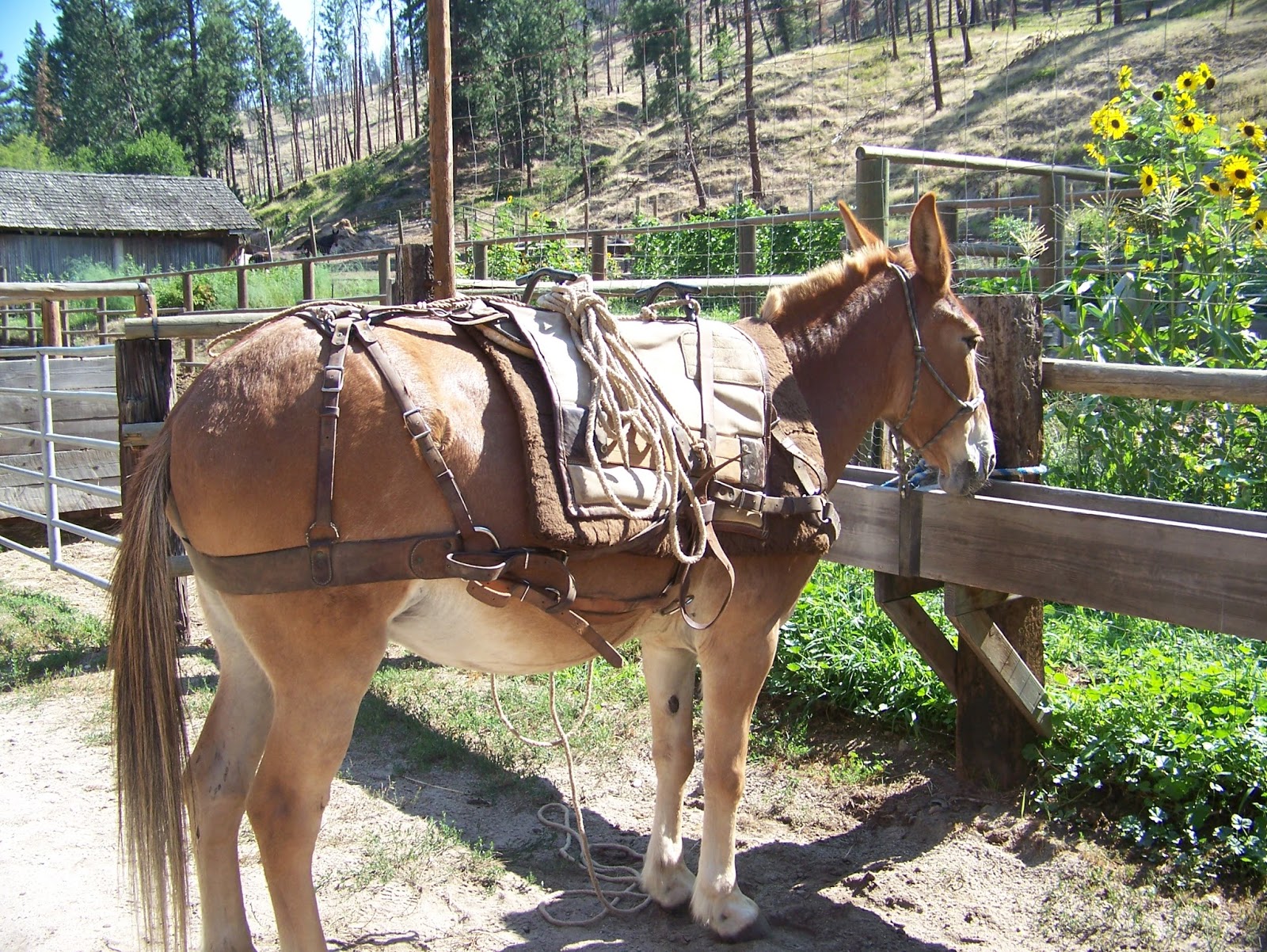
The pack mules are hitched together with a light twine or rope and lead by a rider.  A strong thick rope is not used.  If one mule accidentally goes off the trail the light rope will break and the other mules will not be pulled off the trail.  The mule behind a mule going off the trail will see what is happening and can  potentially brace itself from the fall, but the mule in front will not see and thus could be pulled over and so on.

Everything packed on a mule is placed in a mantie (a large canvas/tarp cloth) or a wooden box.  The packs must be in equal weight on each side of the mule so that the mule is balanced on the trail.  The box is tied with a basket hitch and the mantie is tied with a barrel hitch.

The word mantie is derived from the Spanish, referring to a woman's shawl or scarf called a mantilla.

We take Molly and Itchy for packing and Willy, Jerry and Alfalfa for riding. 

Here Mike and Nathaniel are readying the packs . . . .
 
Itchy ready with his Decker pack saddle . . . .
 
Loading the Molly with a mantie . . . .
 
Back end of Itchy with box and mantie load, ready to go . . ..
 
Itchy loaded with mantie, box and  crosscut saw . . .
 
The saw will be used to clear any trees blocking the trail.  The cross cut saw is a two man saw.
 
Mike does a final check on all saddles and packs before we head out on the trail . . .
 
 
Lorrie again rides her trusty mule,  Alfalfa .. . .
 
Leaving the ranch . . . .
 
Headed up the air strip . . . .
 
On the trail . . . . .
 
I am holding up the rear so if Nathaniel and Mike have to work on the trail I will stop the mules from going back home.  If left unattended/untied the mules will automatically head back to the ranch.
 
Trail goes up a high ridge . . . . .
 
We arrive and Nathaniel unloads the mules . . . .
 
Lynn arrives and hour later with the dogs . . . .
 
Nathaniel and I head home at 2:30 and arrive at the ranch at 4:30 p.m. . .  a long, hot ride.